

• English
  • हिंदी
  • मराठी

Follow Us

Manav Dharma

Home > Manav Dharma

Banner Image

MANAV DHARMA

The Path of True Humanity

“Manav Dharma is a spiritual path based on humanity, truth, and devotion to one Supreme formless God”

The Four Elements

Body

Body

Divine One

Body

Mind

Die or live, in the name of God

Body

Wealth

Restore life by eradicating sorrows

Body

Good Deeds

Desired Food (Desired wish)

The Three Words

Truth, Good Conduct and Love are the three pillars upon which Manav Dharma stands

Truth

Speaking truth

Good Conduct

Keeping the limits

Love

Behaving lovingly

The Five Rules

Follow one God with pure faith, respect and full commitment. This devotion connects a person with divine strength and keeps life disciplined and peaceful.
Speak the truth, maintain moral boundaries and spread love among family and society. This builds trust, unity and a healthy environment for living.
Avoid alcohol, gambling, lottery, theft, lying and anger because they destroy life, family and respect. Women are also guided to use kind and respectful words to maintain harmony at home.
Live with honesty, loyalty and strong character. Integrity builds respect, strengthens relationships and creates a responsible society.
A small and disciplined family lives a better, happier and more balanced life. It helps in giving proper care, values, education and security to each member.

Key Preachings

Corruption can only be controlled with God’s grace.

- Baba Jumdeoji

The purpose of this path is to remove sorrow and achieve enlightenment.

- Baba Jumdeoji

To transform the Iron Age into the Golden Age, truth and good deeds are necessary.

- Baba Jumdeoji

Only those who follow Truth, Good Conduct and Love will remain safe.

- Baba Jumdeoji

There is only one God — God lives within the soul, not in idols.

- Baba Jumdeoji

Show-off and fake display are wrong; live a simple truthful life.

- Baba Jumdeoji

Always speak the truth even if life is at risk.

- Baba Jumdeoji

Don’t just worship God, follow God’s teachings in real life.

- Baba Jumdeoji

We should not worship dead people or ashes.

- Baba Jumdeoji

Dividing people in the name of religion is wrong — humanity is one.

- Baba Jumdeoji

Family planning is necessary.

- Baba Jumdeoji

People should not have more than two children.

- Baba Jumdeoji

Marriage should happen at the right age with proper gap between children.

- Baba Jumdeoji

Support systems should exist for the poor.

- Baba Jumdeoji

Manav Mandir was established for education, unity and development.

- Baba Jumdeoji

Health is wealth — charitable hospitals were created.

- Baba Jumdeoji

Selfless service is the greatest religion.

- Baba Jumdeoji

Establishing the Golden Age is the ultimate goal.

- Baba Jumdeoji

Whoever follows this path will never remain sad or poor.

- Baba Jumdeoji

True spirituality means helping humanity with unity and selfless cooperation.

- Baba Jumdeoji
Superstition Reform

Manav Dharma how it started

Baba Jumdeoji was born into a family that faced extreme hardship and a recurring cycle of loss. His family's home in Timki, Nagpur, was reportedly afflicted by strange occurrences, such as objects falling and sounds being heard in empty rooms. The family believed these phenomena were due to negative spiritual forces or afflictions.

  • The Problem: The family tried various traditional rituals and remedies to stop the suffering, but nothing worked permanently. The head of the family would often die prematurely, leaving the remaining members in distress.
  • The Decision: When Baba Jumdeoji was around 18-21 years old (around 1940-1942), he decided to take on the responsibility of resolving this family crisis. He realized that the conventional methods and superstitions were useless. This crisis led him to seek a genuine, powerful, and ultimate divine solution.

The Search for the Supreme Power

Determined to find the true, singular divine power that could defeat all suffering, Baba Jumdeoji began an intense spiritual inquiry.

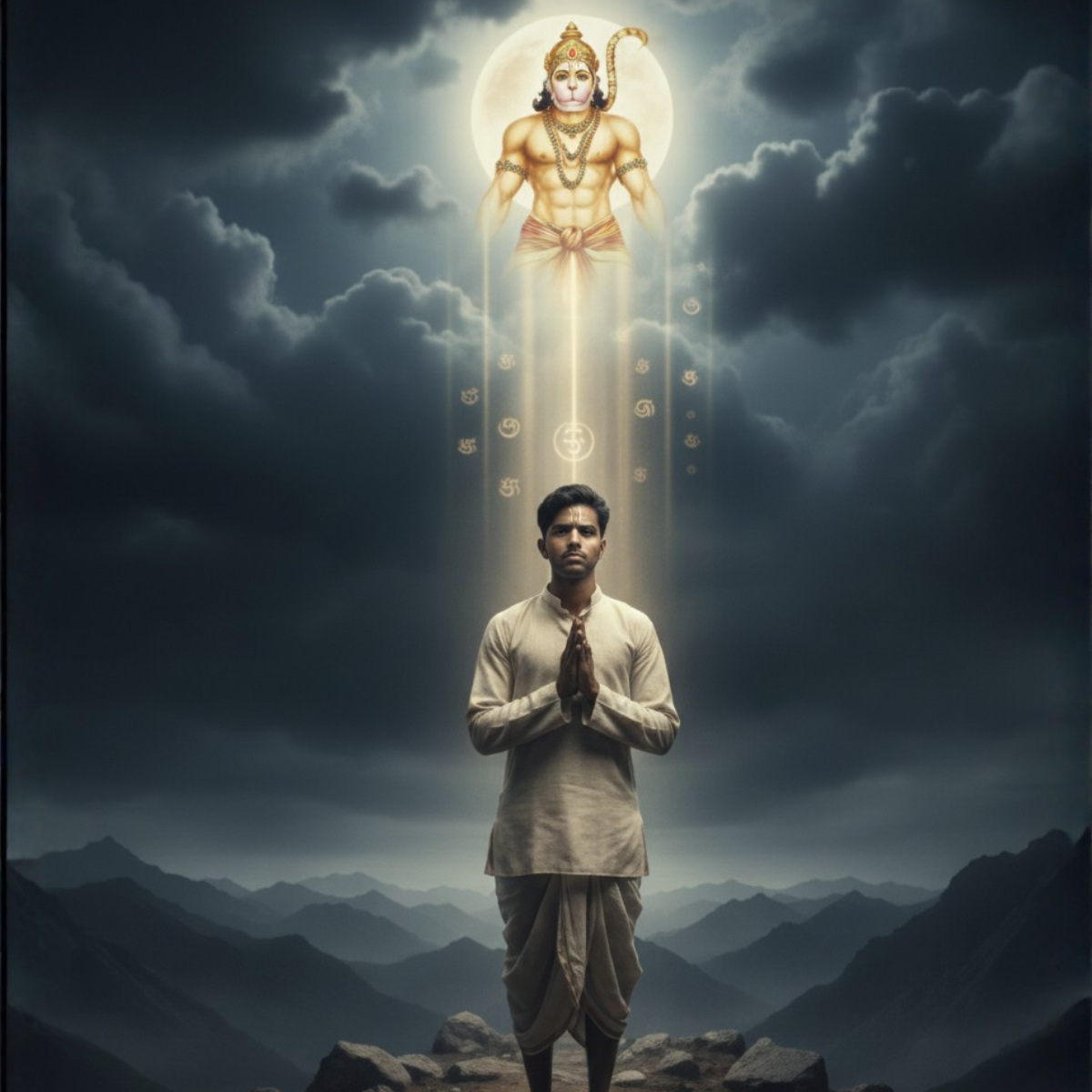
  • The Question: He posed a direct, fundamental question to the divine power he revered (often referred to as Bhagwan Baba Hanumanji in the early stages): "Who is that power in the world that can instantly dispel all negative forces (Saital)? Who is God and who is the ghost? Explain this clearly to me."
  • The Pledge: He vowed to find a solution, even if it meant risking his own life, symbolizing his title Mahan Tyagi (Great Renunciant).
Superstition Reform
Superstition Reform

The Moment of Revelation

In response to his intense devotion and selfless dedication to solving the problem for the sake of his family and humanity, Baba Jumdeoji experienced a profound spiritual realization.

  • The Revelation: He entered a state of Nirakar (formless) consciousness. In this state of complete communion, the Divine (referred to as Param-Eshwari or Baba Hanumanji) spoke through him, revealing the ultimate truth:

    "There is only one Supreme God (Parmeshwar) who created this universe. That God is an ever-awakened, formless (Nirakar) energy that is conscious 24 hours a day."

  • The Core Principle: This moment cemented the central doctrine of "Parmatma Ek" (God is One). He understood that the Supreme God is not bound by form, statue, or complex ritual, but is a singular, omnipresent consciousness.

The Activities Performed to Achieve and Manifest "Parmatma Ek"

Following this divine instruction, Baba Jumdeoji was told how to receive God's grace and bring this power into the world:

The Tri-Tala Havan (Seven-Day Ritual)

To manifest the power of the One God and overcome the family's afflictions, Baba Jumdeoji was instructed to perform a rigorous ritual known as the Tri-Tala Havan (Three-Time Fire Ritual), which he carried out for seven consecutive days.

  • The Nature of the Havan:This was not a traditional, complex Vedic Havan, but an act of complete surrender and selfless work.
  • The Schedule: He performed three havans (sacred fire ceremonies/acts of worship) daily, typically around:
    • 1. First Havan: Performed early in the evening at around 7 PM.
    • 2. Second Havan:Performed late at night (around 11 PM).
    • 3. Third Havan:Performed in the early hours before dawn (around 3 AM, finishing at 5 AM).
  • The Sacrifice:During the day, despite the lack of resources, Baba Jumdeoji continued his work as a weaver to sustain his family. He often went through immense physical and emotional hardship during these seven days, further symbolizing his 'Tyag' (sacrifice).
Superstition Reform
Superstition Reform

Formulation of the Manav Dharma Code

After this rigorous period, the path became clear, and Baba Jumdeojimoved away from complex rituals to focus on a practical, moral, and social code of conduct that directly connects the individual to the One God. This code became the foundation of Manav Dharma (Human Religion).

  • The Focus Shift: Instead of temples and statues, the focus became ethical living, selfless service (Seva), and discipline.
  • The Code (Char Tattva, Teen Shabd, Panch Niyam): He gave his followers (Sevaks) the simple, non-superstitious code of conduct (Four Elements, Three Words, and Five Rules) to live by. The most significant activities he propagated were:
    • 1. Abstinence from Vice:The strict command to give up all bad habits and addictions (alcohol, tobacco, etc.)—this was the practical way to purify the body and mind to realize the pure formless God.
    • 2. Truth, Love, and Limits:Emphasizing social morality through truthfulness (Satya), love toward others (Premane Vyavhar), and observing boundaries (Maryada).
    • 3. Nishkam Karmayoga:Encouraging service and work without attachment to the results, keeping the One God, Parmatma Ek, constantly in mind.

Human Values

Preaching’s of Baba Joomdevji towards Humanity

"The current situation of corruption cannot be handled and
controlled by human beings but it can be brought into control only by God's grace and divine power. If the human beings want to keep themselves secure from the transformation of the Age, they need to follow the path of Truth, Good Conduct and Love to get the divine peace. This message was conveyed on 1st September, 1980."

"The purpose of this divine path is to follow the path of Truth, Good conduct and Love that destroys each and every sorrow of the follower of this who becomes the Enlightened One. This message was conveyed on 16th February, 1991, at Sevak Sammelan, Ramtek, and District Nagpur."

"The Almighty will transform the Iron Age into the Golden Age where only truth prevails. Every person must seek enlightenment, repent for misdeeds, honor Bai Sati like Renuka, trust divine power, and perform good deeds for family and Sevaks. (Message: 28 Sept 1990, Lalganj, Nagpur)"

"The Citizens of this country should become Enlightened 0nes because it is the transformation of the Age. After the Iron Age, there will be the Silver Age. It is the cycle of the Ages. Only those who follow the path of Truth, Good Conduct and Love shall remain safe and secure when the Day of Judgment will come."

"There exists only one God and we should not search God in the idols. God exists in every human soul and does not exist in physical form to identify."

"Baba was strictly against pretentious behavior like keeping long hair, beard, wearing Rudraksh and other beads, keeping Kamandal etc. and believed in simplicity."

"Truth signifies brave and fearless expression of heart. Words spoken to appease others take us towards falsehood. One should always speak the truth even if it endangers one’s life because God loves truth and his truthful followers."

"Baba believed that we should follow the path taught to us by Gods for example Lord Rama destroyed evil in the form of Ravana. We should follow the path shown by Lord Rama rather than just worshipping lord Rama's idol."

"Baba was against worshipping the Deads as after death a man vanishes in the supreme God and what remains of him is only ash of his body, so it is uncalled for to worship the ash. A man with truthful means and undivided attention towards a single goal with faith in one God can accomplish his or her desired tasks."

"Baba was against dividing humans in the name of religion and religious practices because according to his philosophy dividing humans is like dividing God."

"Baba was farsighted in his approach and preached family planning laying down following conditions for his followers, 1. One should not have more than two issues and should follow family planning measures consulting the doctors. 2. The age of marriage for a male should not be less than 25 years and Baba advocated proper gap between two issues, so that the family size should be small and the mother remains healthy."

"Baba promoted the cooperative system to uplift poor and illiterate followers exploited by moneylenders. For their welfare he introduced cooperation and fundraising, establishing Sevak Nagrik Sahkari Bank, Sahakari Grahak Bhandar, and Dugdha Udpadak Sahakari Sanstha, giving both spiritual and practical support for daily life."

"Baba established “Manav Mandir" for the all-round
development of his disciples and their children. “The Manav Mandir” consists of school, playground, houses, Library and seminar Hall where thousands of disciples gather on every 15th November and bring food with them. After the preaching and havan they eat together and enjoy togetherness."

"Baba believed in the doctrine of “health is wealth” because only a healthy person can understand the real meaning of life and can enjoy the blessing of God. For this purpose he established a charitable hospital near Mohadi Village in Bhandara District."

"Baba was an apostle of selfless service to mankind and taught that the core principle of Manav Dharma is sacrifice. He was dissatisfied with the existing democracy, believing the nation was ruled by the rich and misguided. As people’s daily conduct went against divine law and conditions worsened, Baba urged the creation of ‘Satyug’ by establishing truth in the universe."

"Disciples coming on this path cannot be ever sad in his life
after getting rid of grief and suffering. And cannot remain poor. This is Baba's claim. However, the 4 Elements, 3 Words and 5 Rules given by the baba’s should always have to follow by all disciples and the words of Baba should be understood by understanding the word of God. Dated 24th Feb 1991, Sevak Sammelan, Nagpur."